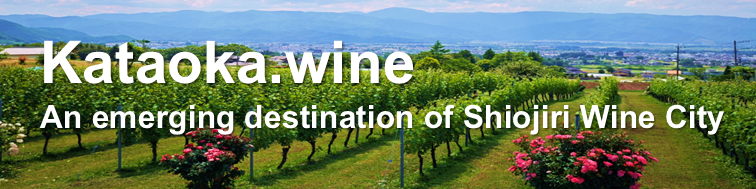
Kataoka is a district in the northeastern part of Shiojiri City, stretching across the gentle western slopes from the ridgeline of Mt. Takabotchi (1,665 meters) down to the right bank of the Tagawa River (650 meters). The name “Kataoka” is said to derive from the fact that only one side of the area forms a gentle hilly terrain.

The Higashiyama Sanroku Line, a Shiojiri municipal road that connects the Shiojiri Interchange on the Nagano Expressway with central Matsumoto, runs north to south through Kataoka. This road is also known as the “Alps Observation Shinonome Road.” Looking west, beyond the Hirooka district and the alluvial fan between the Tagawa and Narai rivers, one can enjoy distant views of the Northern Japan Alps rising to 3,000 meters.
According to The History of Shiojiri’s Settlements: Kataoka District (Shiojiri City History, 1995), the peak of Mt. Takabotchi, located east of Kitakumai, was given its name in 1910 during the topographic surveys of the Imperial Japanese Army. Before that, the area was overgrown with wild grapevines and was locally referred to as “Budō” (grape).
At elevations of 700–800 meters along the mountain foothills, a number of Jomon-period sites can be found, including the Takenohana Site, the Shuto-yashiki Site, the Komaruyama Site, and the Yaguchi Site. Grapes were surely part of the lives of the people who lived here in ancient times as well.
During the Edo period, the Higashi Kaidō, a branch route of the Nakasendō, connected Shiojiri-juku with Matsumoto Castle Town, with settlements such as Nakabasami, Minamikumai, Kitakumai, Kimiishi, Uchidahara, and Minamiuchida forming a chain along the way. In 1874 (Meiji 7), these settlements were organized as Kataoka Village, which later merged into Shiojiri City in 1959 (Shōwa 34).

Water from mountain springs was limited, so residents built irrigation channels and reservoirs to cultivate their fields. The windy slopes of Kataoka were well suited to mulberry cultivation, and during the Meiji and Taishō eras, much of the farmland was converted into mulberry fields to support the growth of sericulture and silk-reeling industries. However, in the Shōwa era, the industry declined due to the collapse of exports during the Great Depression and the rise of synthetic fibers.
In 1950s, dairy farming was promoted, and at one point, Kataoka Village was said to have the highest milk production in Nagano Prefecture. Fields also produced wheat, beans, and root vegetables. From 1977 (Shōwa 52), farmland consolidation was carried out to enable the use of large agricultural machinery. However, during the Heisei era, a decline in full-time farmers and a shortage of successors led to an expansion of abandoned farmland.
Today, Kataoka is attracting attention as a promising area for cultivating wine grapes.

Community revitalization through winemaking
Chimazou Komatsu
Chairman, Kataoka Wine Promotional Council
In the Kataoka district of Shiojiri City, efforts to improve farmland and enhance agricultural practices began in the late 1970s, with the goal of revitalizing local life through community-based farming. These efforts led to the expansion of vegetable cultivation.
In Nagano Prefecture, wine grape cultivation has grown by leveraging the region’s favorable climate and diverse altitudes. In 2002, the prefecture launched the Nagano Appellation Control (NAC) system to certify the local origin and quality of wine. In 2012, it introduced the Shinshu Wine Valley Initiative to accelerate the development of the regional wine industry.
In Kataoka as well, grape cultivation is drawing attention as a means of utilizing idle farmland left behind by an aging farming population and a shortage of successors. These efforts also build on Shiojiri’s winemaking traditions, particularly those centered around the Kikyogahara area. The area’s varying elevations, soil characteristics, abundant sunlight, and favorable airflow create ideal conditions for wine grape cultivation, sparking increased interest among local winemakers and producers.
In response to these growing expectations, the Kataoka Wine Promotion Council was established in 2023. The council aims to foster modern agriculture and winemaking, while contributing to the creation of a more sustainable and livable community.
Kataoka also boasts striking natural and historical attractions, including panoramic views of the Japan Alps from the Sanroku Line—also known as Shinonome-no-Michi—and the scenic vistas from the ruins of Kitakumai Castle. Together with the local community, we are working to share these distinctive features of Kataoka alongside its wine, so that more people can discover and appreciate the region’s unique offerings.